Claude Max 20x vs 5x (now Ultra vs Max): is it worth it? We measured the limits
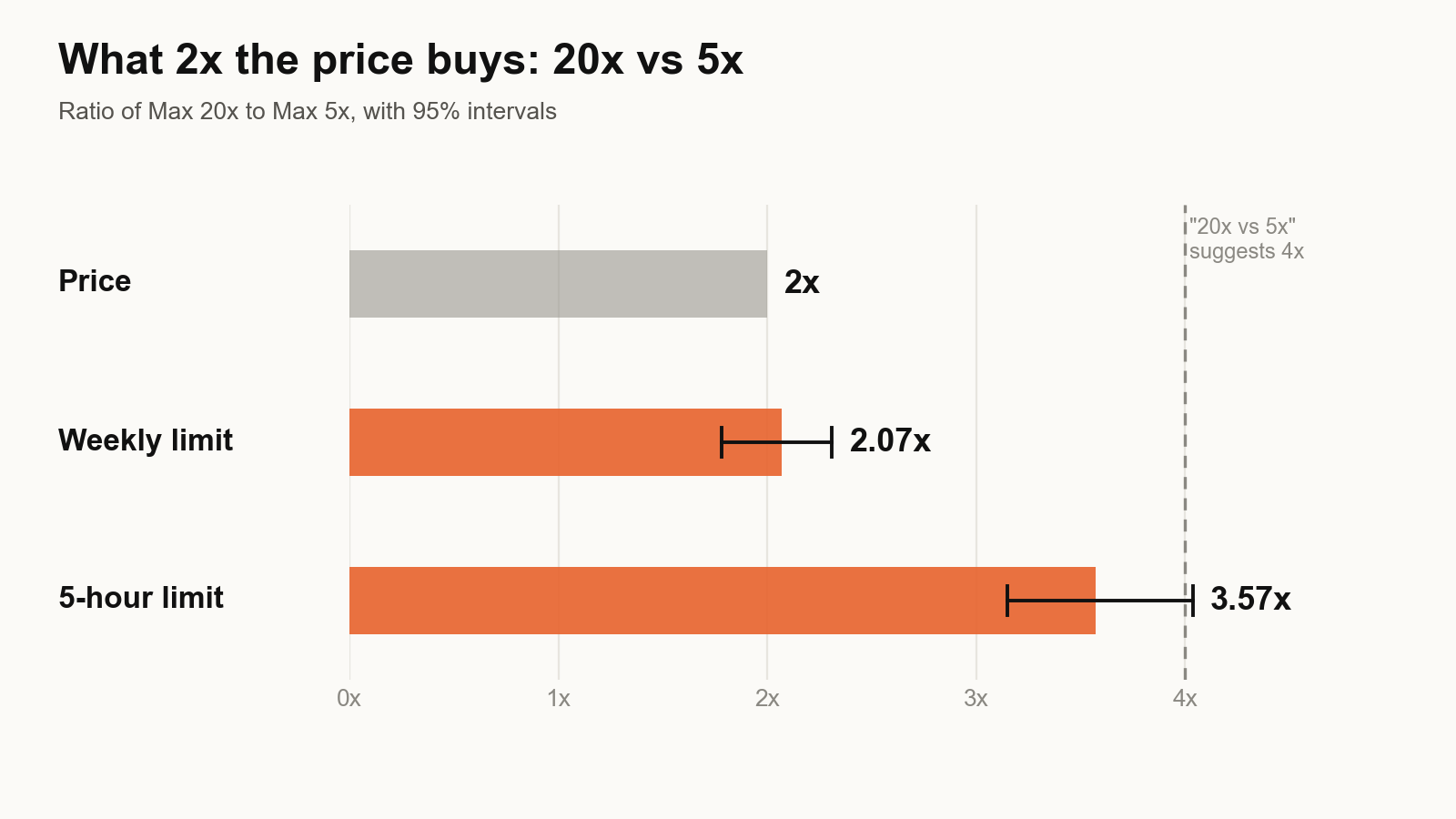
Max 20x, now Ultra, costs twice Max 5x. Measured on real Claude Code use, it gives 2.0x the weekly limit: the same value per dollar, and no 5-hour limit.

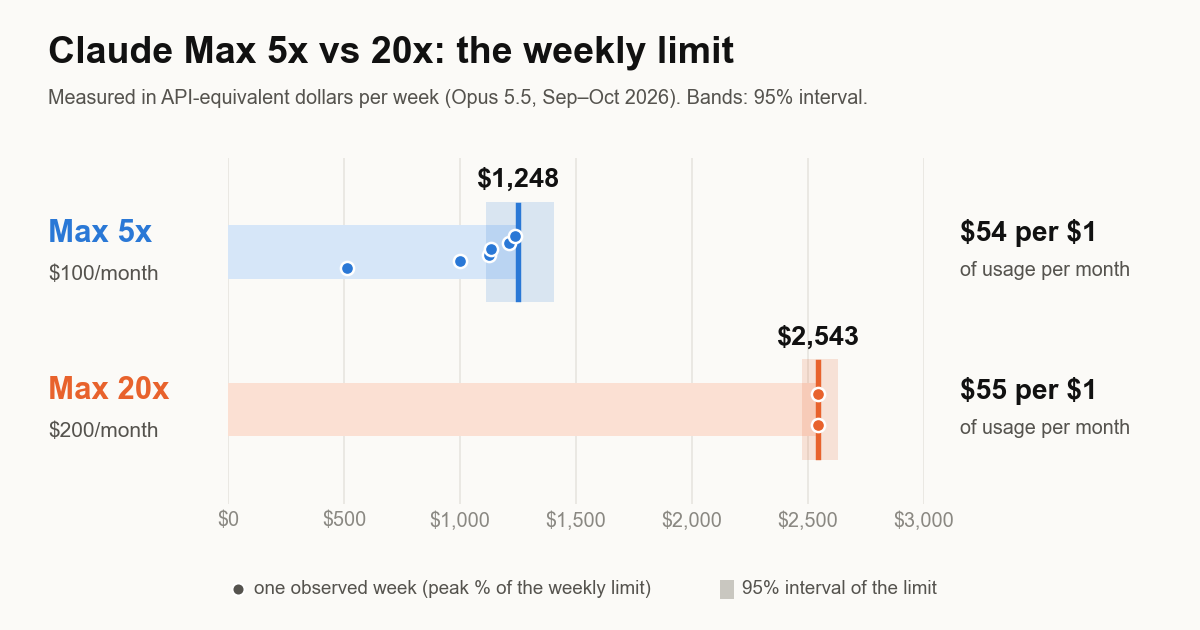
Claude Max 20x costs $200 a month. Max 5x costs $100. The names suggest four times the usage for twice the price. When we measured, Anthropic only promised that multiple for the 5-hour session limit. It did not say how the weekly limit scales.
So we measured both plans on the same heavy Claude Code account, with hourly readings of the usage meter matched to the token logs.
Updated November 27, 2026: we rechecked the weekly limit on Ultra from November 14 to 27; the data can’t confirm or rule out a change (see How we measured). On October 30 Anthropic renamed Max 20x to Ultra and Max 5x to Max, at the same prices. Verified Ultra accounts no longer have a 5-hour limit. Anthropic now gives the weekly ratio itself: Ultra is 10x Pro per week and Max 5x, the 2x we measured. Claude Fable 5.2 has its own weekly limit on both plans; we measured that too.
The short answer: Max 20x (now Ultra) gives about 2.00x the weekly limit of Max 5x (now Max), for twice the price. It gave 3.66x the 5-hour limit, and since October 30 verified Ultra accounts have no 5-hour limit at all.
| Max 5x (now Max) | Max 20x (now Ultra) | 20x vs 5x | |
|---|---|---|---|
| Price per month | $100 | $200 | 2x |
| Weekly limit (API-equivalent) | $1,248 | $2,494 | 2.00x |
| 5-hour limit (API-equivalent) | $125 | $457, now none on verified accounts | 3.66x |
| Fable 5.2 limit per week | about $320 (estimate) | about $640 | 2x |
| Usage per $1 of plan price, per month | $54 | $54 | equal |
Per dollar, the two plans give you the same weekly usage. What 20x added was room inside each 5-hour window, and Ultra now removes that window. That decides how easily you actually get to 100% of the week.
How much more weekly usage does Max 20x give?
About 2.00x the weekly limit of Max 5x (95% interval: 1.72x to 2.42x). In API-equivalent dollars, a full week held about $1,248 on Max 5x and $2,494 on Max 20x.
“API-equivalent” means what the same tokens would cost on the Anthropic API at list price. It’s the easiest common unit for usage that mixes input, output and cached tokens. It’s a measure of usage, not money you pay. The 95% intervals: $1,032 to $1,447 for Max 5x, and $2,418 to $2,593 for Max 20x.
The dots in the chart at the top are real weeks: the highest weekly percentage the meter reached in that week, valued at the measured limit. The last six weeks on Max 5x peaked between 41% and 99%. All four weeks on Max 20x reached 100%.
Why it isn’t 4x
Anthropic’s Max plan page defines the tiers per session: Max 20x “includes 20 times the Pro plan’s per-session usage allowance”, and Max 5x five times. Separately, “Max plans also have a weekly usage limit that applies across all models.” No multiple was given for that weekly limit, and in our measurement it does not follow the session multiple.
Since the rename, Anthropic does give one. Ultra gets “10 times the Pro plan’s usage every week”, and Max five times. That is 2x, which matches what we measured.
Why other numbers differ
The ratio moves with the period you measure. Classmethod measured about 3.5x in August 2026, with Max 5x at roughly $1,000 to $1,200 and Max 20x at $3,400 to $3,900 per week. That was during Anthropic’s weekly limits promotion, which raised Claude Code weekly limits by 50% from May 13 to September 13, 2026. Since September 14, Claude Code weekly limits are 25% above their pre-promotion level.
Our numbers come from after the promotion, on a different model and account. We can’t fully reconcile the two results. What they do agree on: the weekly ratio is not the 4x the plan names suggest, and nobody outside Anthropic knows the exact figure for your account.
The 5-hour limit is where Max 20x pulls ahead
Since October 30, 2026, verified Ultra accounts have no 5-hour limit, so on Ultra this whole section now applies only to Max. Our account lost its 5-hour limit with the rename. The measurements below are from Max 20x before that date.
The 5-hour limit scales much closer to the name: 3.66x (95% interval: 3.16x to 4.28x). A full 5-hour window held about $125 on Max 5x and $457 on Max 20x.
That difference matters more than it looks, because the two limits interact. On Max 5x, one full 5-hour window is 10% of the week. To use the whole week you need ten maxed-out windows. On Max 20x, one window is 18% of the week, so five or six full windows use it up.
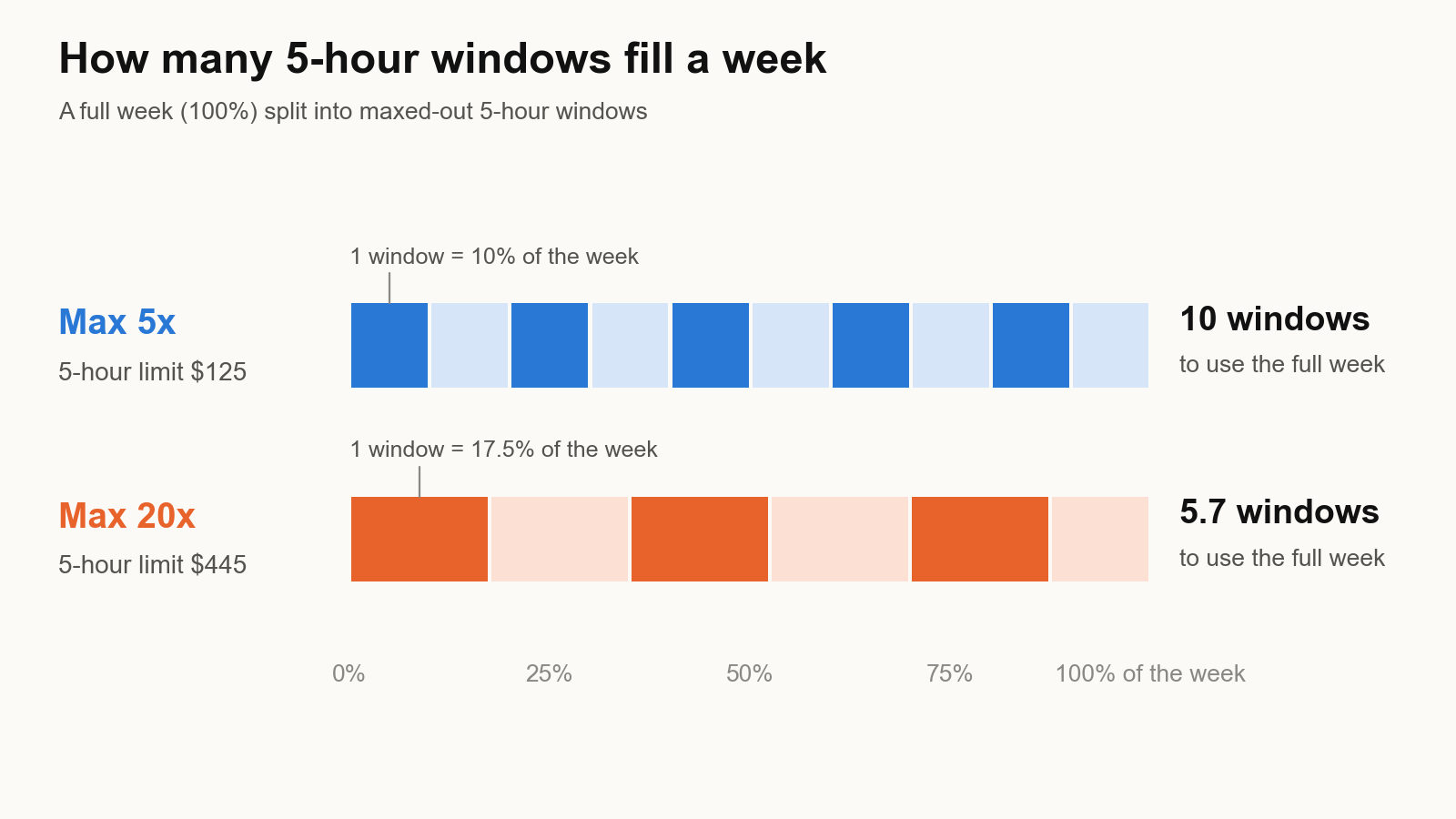
A working day holds two or three 5-hour windows. On Max 5x, using the full week therefore means three to four days of hitting the 5-hour limit, window after window. On Max 20x, two heavy days can carry most of the week.
What that looks like in practice
The chart below shows every 5-hour window the account used, by how full it got. The last two weeks on Max 5x come first, then the first three weeks on Max 20x.
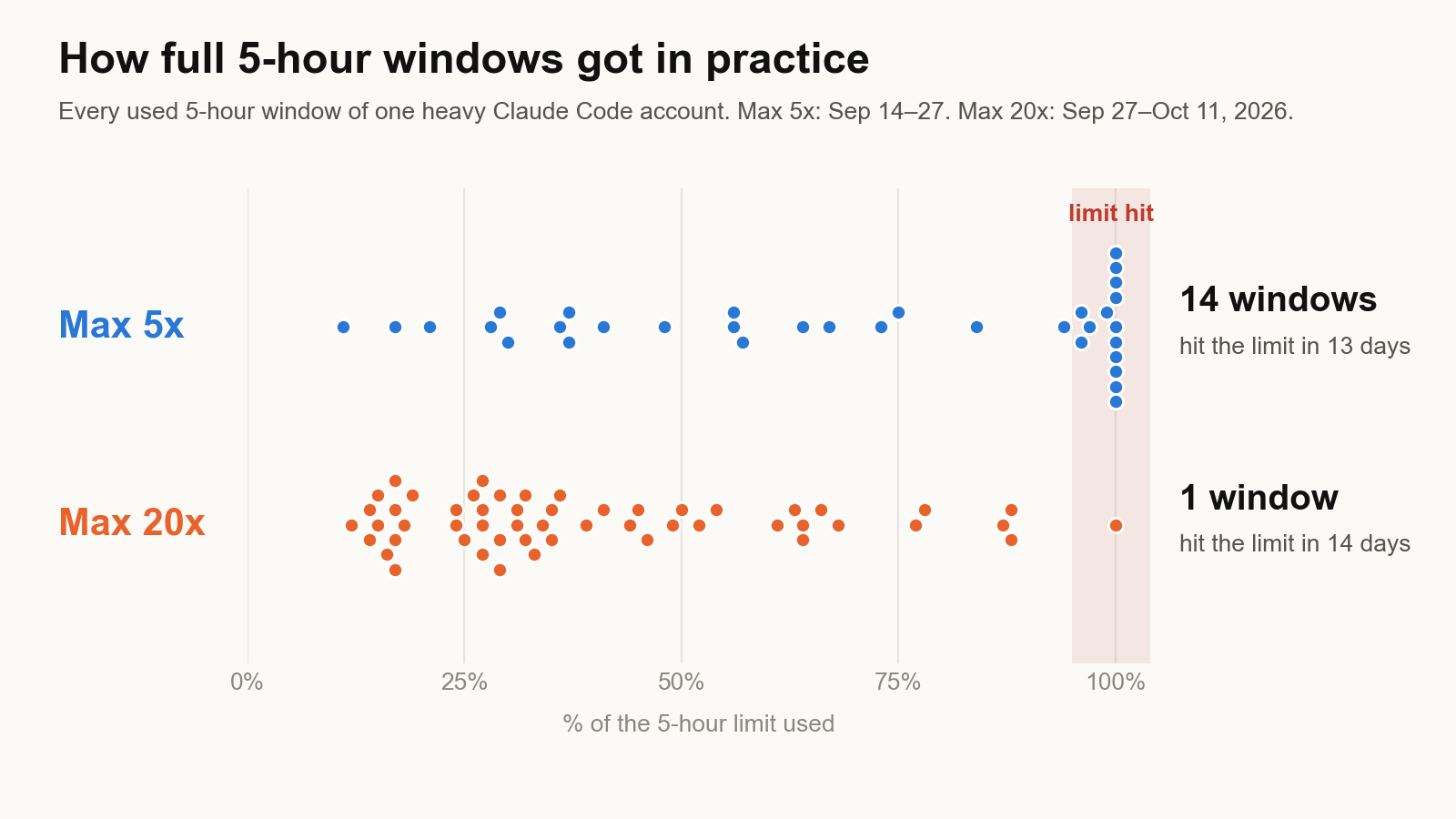
- Max 5x: 14 windows hit the 5-hour limit in 13 days. A used window typically reached 74% of its limit. The busiest day used 33% of the week.
- Max 20x: 3 windows hit the limit in 22 days. A used window typically reached 35%. The busiest day used 62% of the week.
The usage pattern was not identical: the account was used more heavily after the upgrade. The direction is still the point. On Max 5x the 5-hour wall cuts heavy days short, so the weekly limit is hard to reach. On Max 20x the wall rarely comes, and the weekly limit becomes the only one that matters.
Is Max 20x worth it?
Per dollar, the plans are equal: about $54 of usage per $1 on both, per month at full use (the weekly limit times 4.33 weeks, divided by the price). The ratio of the two is 1.00 (95% interval: 0.86 to 1.21). The extra $100 for Max 20x buys about $1,246 more usage per week, which is $54 per extra dollar.
So the question is not value per dollar. It is whether you can use the weekly limit you pay for.
| Your typical week | Max 5x (now Max) | Max 20x (now Ultra) |
|---|---|---|
| Light use, rarely hits the 5-hour limit | Same value, half the price | More room than you use |
| Hits the 5-hour limit most days, week ends below ~90% | Blocked during the day | Worth it: no 5-hour limit on verified Ultra accounts |
| Needs more than ~$1,250 of usage a week | Runs out | Worth it |
| Uses Fable 5.2 for more than a few hours a week | Fable limit after about 8 hours | Worth it: about 17 hours |
| Needs more than ~$2,500 a week | Runs out early | Runs out too |
To see where you are, open the usage page in Claude settings or run /usage in Claude Code. Watch two things: how often you hit the 5-hour limit, and how full your week is when it resets.
What 1% of the meter is worth
| Meter | 1% of the limit equals |
|---|---|
| Max 5x, 5-hour | $1.25 |
| Max 5x, weekly | $12.50 |
| Max 20x, 5-hour | $4.57 |
| Max 20x, weekly | $24.90 |
At this account’s typical pace of $25 to $34 of usage per active hour, the Max 5x 5-hour meter moves 20 to 27% per hour. On Max 20x it moves 6 to 7%. The Max 20x weekly meter moves about 1% per active hour, so it fills after roughly 75 to 100 active hours.
What happens to your usage when you upgrade mid-week
The account upgraded from Max 5x to Max 20x in the middle of a week, with the weekly meter at 77%. The next reading, about an hour later, showed 4%. The weekly counter started over at the upgrade, and the reset day stayed the same. Billing was prorated for the rest of the month.
That is one observation, not a documented rule. Anthropic’s page says the weekly limit “resets at a fixed time each week that is assigned to your account” and that “you receive your full weekly allowance each cycle”. It does not describe upgrades.
How we measured
- Meter readings: CodexBar records the Claude usage meter (5-hour and weekly percentage) about once an hour and keeps the history locally.
- Usage: every request in Claude Code’s local logs, priced at each model’s Anthropic API list rates. Almost all of it is Opus 5.5: $4 per million input tokens, $20 output, $0.20 cache reads, $5 or $8 cache writes (5-minute or 1-hour cache).
- Scripted runs: some of this account’s batch jobs call
claude -pwithout saving a transcript. They count on the meter but are missing from Claude Code’s logs. We added them from the cost each job logs, spread evenly over the run where a job logs one total. Without them, usage explains the Max 20x meter poorly (R² 0.59). With them, the fit is close. - Calibration: for each pair of consecutive meter readings, we took the change in percentage and the usage in between. The limit is the total usage divided by the total percentage gained. Readings taken while a meter stood at 100% are left out, because a full meter can’t show more usage. The 95% intervals come from resampling whole days (bootstrap, 4,000 draws).
- Sample: Max 5x from September 22 to 27, 2026 (131 weekly and 92 five-hour intervals). Max 20x from September 27 to October 19 (485 weekly and 406 five-hour intervals). An earlier Max 5x stretch, September 14 to 22, gives similar values ($1,211 per week, $130 per 5 hours) with wider intervals.
- Cross-check: when this account hit its weekly limit on October 19, work moved to a second Max 20x account. Its first two days give a weekly limit between $2,250 and $2,760, depending on how a few unattributed scripted runs are counted. That agrees with the main result.
- After the rename: from November 14 to 27, on Ultra, we read the weekly meters of this account and of the second Ultra account every 30 minutes, and added them up, because scripted runs can bill to either. Fable 5.2 usage counts at twice its list price, rounded down from its measured weight on the meter of about 2.3x, so the figures are in Opus-equivalent dollars. With every scripted run counted, a full week comes out at $2,270 (95% interval $2,180 to $2,390), and usage explains 95% of the meter. Scripted calls that fail leave no cost behind, so that is a lower bound, and it can sit below $2,494 without the limit having changed. Hours without scripted runs give about $3,130 ($2,220 to $3,780), but from only 17 percentage points over six days. So this recheck can’t tell whether the rename changed the weekly limit.
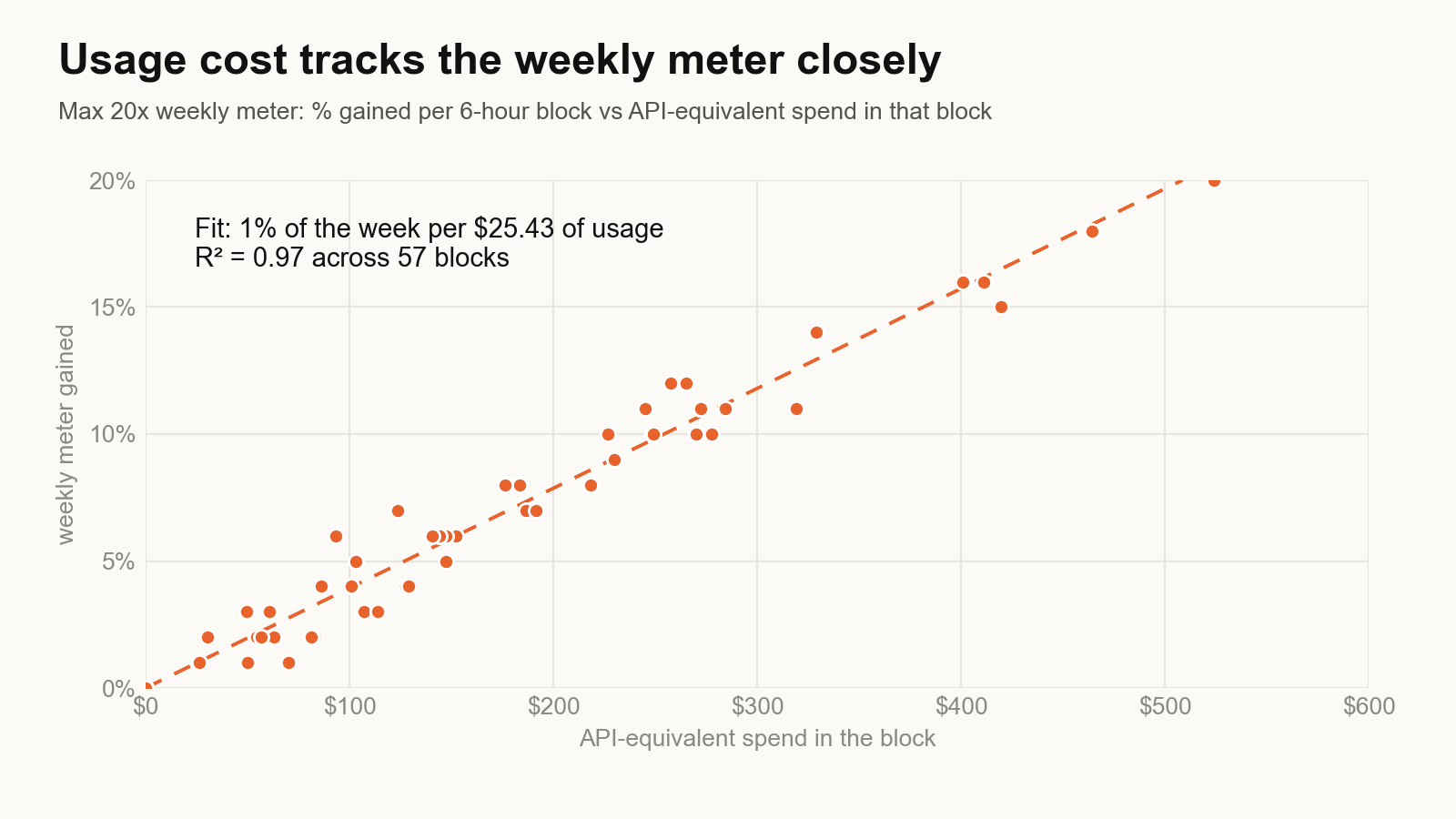
The check that matters: does usage in dollars actually explain the meter? On Max 20x it does, closely. Usage explains 97% of the variation in the weekly meter per 6-hour block.
Limits of this measurement:
- It is one account, used almost entirely with Opus 5.5 in Claude Code.
- The Max 5x sample is short (six days).
- The meter shows whole percentages.
- Anthropic’s internal weights are not public. Dollar value is a proxy that fits well here, but other models or usage mixes may weigh differently.
- Anthropic can change limits at any time. These numbers describe September and October 2026.
FAQ
Is Claude Ultra the same as Max 20x?
Yes. On October 30, 2026, Anthropic renamed Max 20x to Ultra and Max 5x to Max, at the same prices. The difference: verified Ultra accounts no longer have a 5-hour limit, only weekly limits.
Is Claude Max 20x four times Max 5x?
Only per session, and only roughly. In our measurement Max 20x gave 3.66x the 5-hour limit and 2.00x the weekly limit of Max 5x, for twice the price. Anthropic now states the weekly ratio too: Ultra is 10x Pro and Max 5x, so 2x.
How much Fable 5.2 do Max and Ultra include?
Both have a separate weekly Fable limit of up to 50% of the weekly limit. On Ultra we measured about $640 of usage at API list prices per week, about 17 hours of Claude Code. On Max we estimate half that.
How much more weekly usage does Max 20x give than Max 5x?
About twice as much: 2.00x, with a 95% interval of 1.72x to 2.42x, measured on one account in September and October 2026. During Anthropic’s May to September 2026 promotion, one other measurement found about 3.5x.
Is Max 20x worth the extra $100?
It gives the same usage per dollar as Max 5x, about $54 of API-equivalent usage per $1. It is worth it if you hit the 5-hour limit most days or need more than about $1,250 of usage a week. If neither is true, Max 5x gives the same value for half the price.
Does upgrading reset the weekly limit?
In our one observation, yes: the weekly meter went from 77% to 4% right after the upgrade, and the reset day stayed the same. Anthropic does not document this, so treat it as likely rather than guaranteed.