Claude Max 5x vs Codex Pro 5x: we measured both $100 plans
Both cost $100 a month. Measured on real use, Claude Max 5x held $1,248 of API-equivalent usage a week and Codex Pro 5x $325, but Codex had no 5-hour limit.

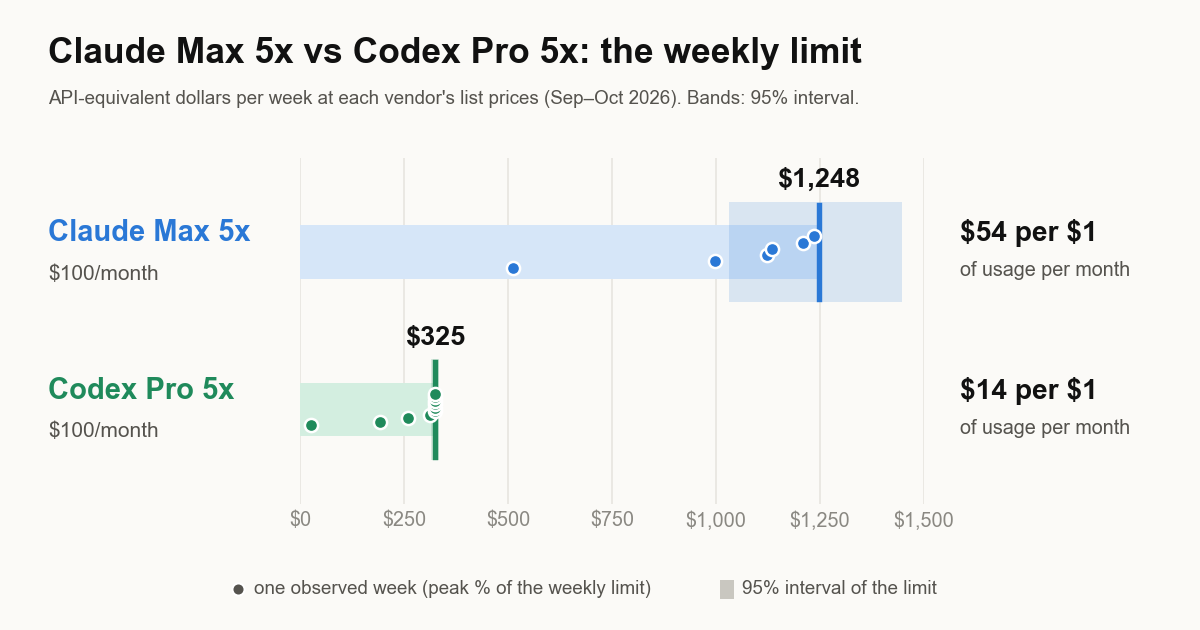
Anthropic’s Claude Max 5x and OpenAI’s Codex Pro 5x both cost $100 a month, and both sell themselves as five times the $20 plan. We used both on the same heavy coding workload in September and October 2026, and measured how much usage a week of each actually holds.
The short answer: Claude Max 5x held about 3.8x the API-equivalent usage of Codex Pro 5x per week, and about 6x the input and 3x the output tokens. In daily use it also got far more work done. The one thing Codex Pro does better: it had no 5-hour limit, so a heavy day never got cut off.
| Claude Max 5x | Codex Pro 5x | |
|---|---|---|
| Price per month | $100 | $100 |
| Weekly limit (API-equivalent) | $1,248 | $325 |
| Usage per $1 of plan price, per month | $54 | $14 |
| Tokens per full week, input / output | 2.67B / 8.0M | 454M / 2.9M |
| 5-hour limit | Yes, 10 full windows per week | None |
| Busiest day, share of the week | 33% | 83% |
| Early weekly resets | Rare | 20 in 12 weeks (Plus and Pro) |
How much does a week hold on each plan?
A full week on Claude Max 5x held about $1,248 of usage (95% interval: $1,032 to $1,447). On Codex Pro 5x it held about $325 ($314 to $335).
The dots in the chart at the top are real weeks: the highest weekly percentage the meter reached in that week, valued at the measured limit. The last six Claude Max 5x weeks peaked between 41% and 99%. Six of the ten Codex Pro weeks reached 100%; the others were cut short by an early reset.
“API-equivalent” means what the same tokens would cost on each vendor’s API at list price: Anthropic’s prices for the Claude usage, OpenAI’s for the Codex usage. It measures usage, not money you pay. At full use that is $54 of usage per $1 of plan price on Claude and $14 per $1 on Codex (the weekly limit times 4.33 weeks, divided by $100).
That dollar gap is partly a price gap. Most of the Codex usage ran on GPT-6 Astra, which lists at $10 per million input tokens, $50 output and $1 cached. Claude Opus 5.5 lists at $4, $20 and $0.20. So the same tokens cost more at OpenAI’s prices, and a comparison in API dollars doesn’t transfer one to one to work done. Counting tokens instead of dollars narrows the gap but doesn’t close it.
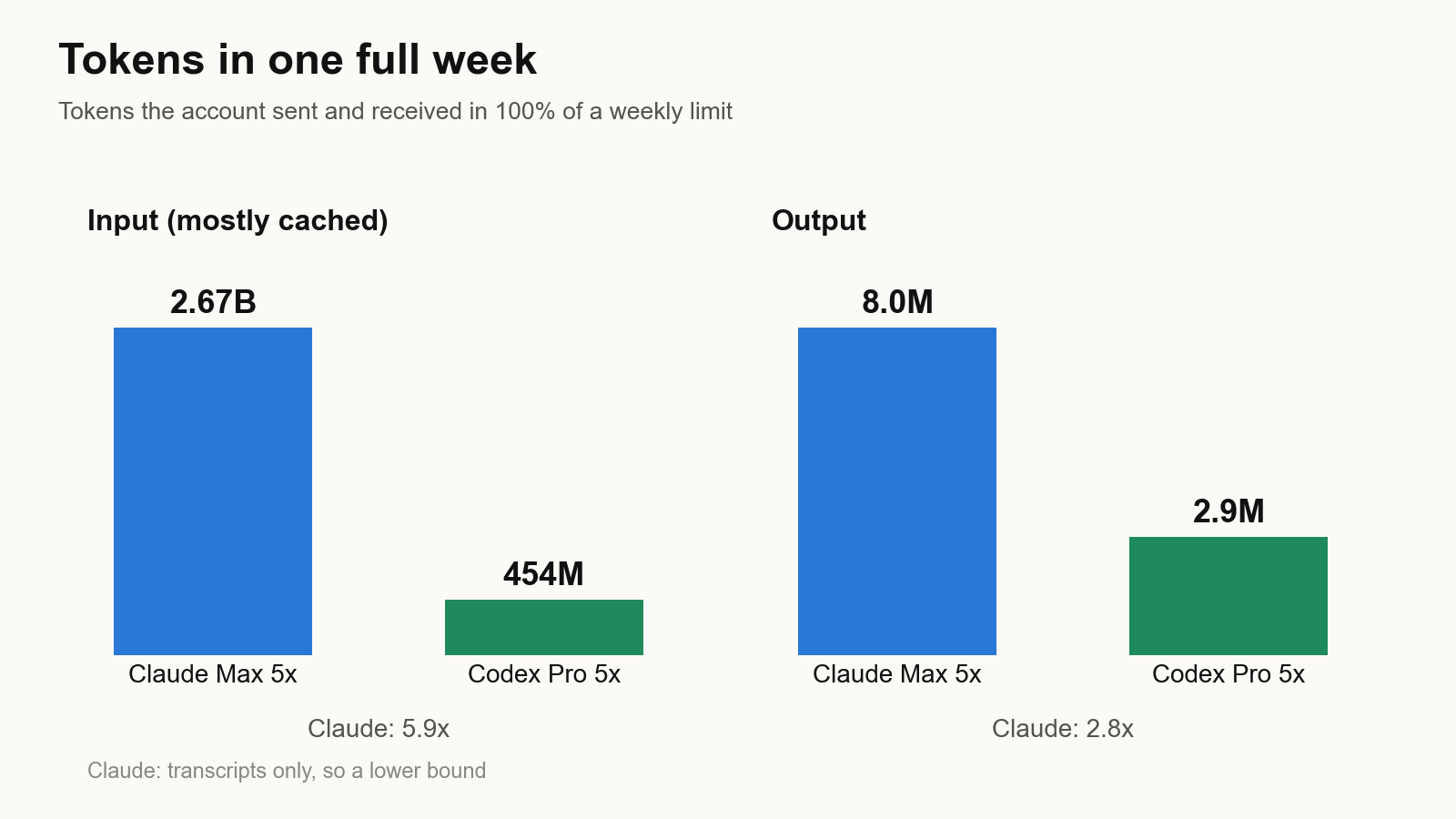
Most input on both plans was cached context: 98% on Claude, 96% on Codex. The Claude count includes only sessions that left a transcript, so the real Claude figure is higher still.
Tokens are not equal units of work across two different models. A model that solves a task in fewer tokens gets more done per token. We didn’t measure output quality, only how much each plan lets you run.
Codex Pro had no 5-hour limit
Claude Max has two limits: a 5-hour session limit and a weekly limit. On Max 5x, one full 5-hour window is about 10% of the week, so using the whole week takes about ten maxed-out windows. Codex Plus has both limits too. Codex Pro 5x had only the weekly one.
That changes how a week gets spent. With no 5-hour wall, nothing stops a heavy day.
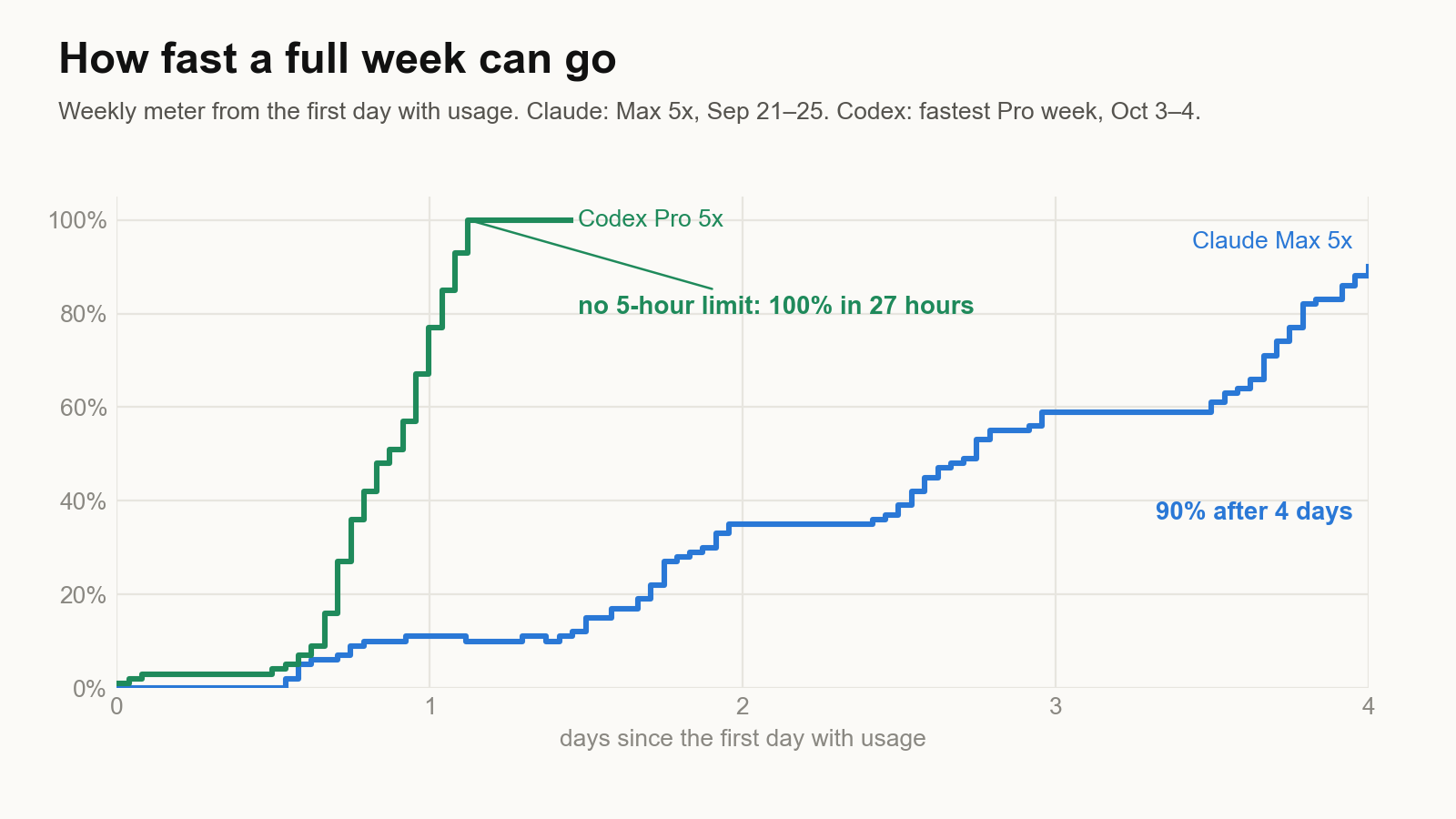
- Codex Pro 5x: the busiest day used 83% of the week. The fastest week went from empty to 100% in 27 hours. The account reached the weekly limit six times in 30 days. That is more than four because Codex restarted several weeks early (more on those resets below).
- Claude Max 5x: the busiest day used 33% of the week. The 5-hour limit cuts a heavy day off long before the week runs out.
This is where Codex Pro wins. On Claude Max 5x the 5-hour limit is the one you keep running into, often in the middle of a task, and then you wait. On Codex Pro that never happened. The price is that one long session can eat the whole week.
Not every Codex model counts the same
OpenAI says the number of messages you can send “depends on the model used”. Our data shows how much. Measured against the weekly meter, the cost per 1% of the week differs by model:
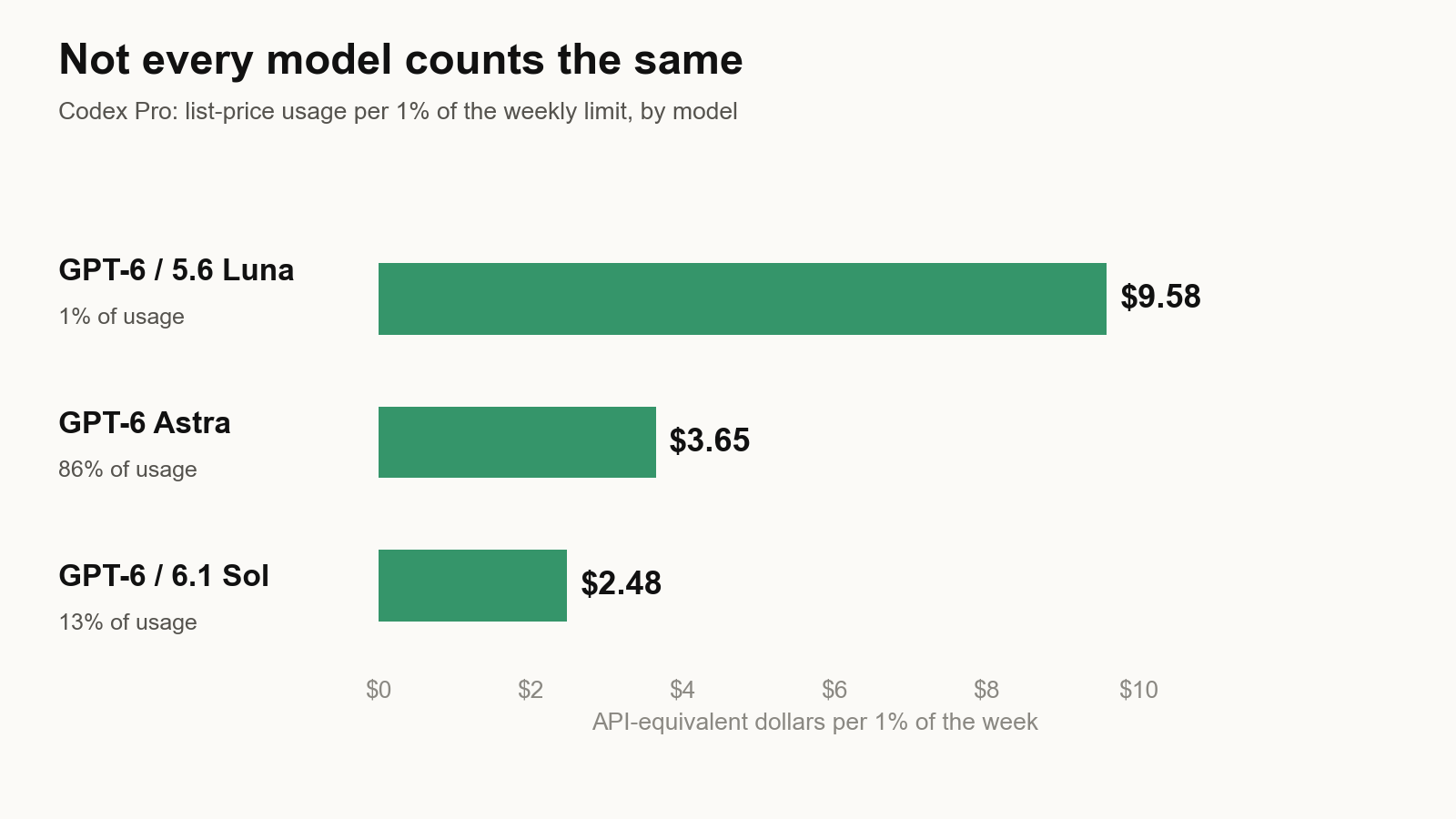
Per dollar of list price, Sol takes about 1.5x as much of the weekly limit as Astra. Luna takes much less. So the $325 holds for a week of mostly Astra. A Sol-heavy week holds fewer API-equivalent dollars, and a Luna-heavy week more. On Claude Max the weights matched list prices closely, but that account ran almost entirely on one model.
Is Codex Pro 5x really five times Plus?
OpenAI launched the $100 tier with “5x higher limits than Plus”. The same account went back to Plus after the Pro month, and a full Plus week held about $63 ($60 to $73). That is 5.1x for Pro. But the Plus weeks ran on Sol and the Pro weeks on Astra. Corrected with the model weights above, Pro comes out at 3.7x (3.2x to 4.0x). The answer depends on the correction, so we can’t confirm the 5x.
What it was like in daily use
The measured gap matches how the two plans felt. Comparing the models we see as closest, Claude Opus 5.5 and GPT-6.1 Sol, we got far more work done in a week on Claude Max 5x than on Codex Pro 5x. Even with the 5-hour limit in the way, Claude felt like much more value for the money.
Codex resets look generous, but give back less than you’d think
Codex hands out early resets of the weekly limit often. Claude rarely does. Between August 1 and October 21, across Plus and Pro, the Codex weekly meter restarted early 20 times: about 1.7 times a week.
A reset is less of a gift than it looks:
- It restarts the week, too. After every reset, the next one moved to seven days later. The only gain is the days you would otherwise have waited for the old week to end. That only matters if you run out early.
- You often don’t pick the moment. Many resets arrived on their own. Five of the 20 came with 10% or less of the week used, so they gave back almost nothing. Eight came at 95% to 100%, where a reset does help.
Resets feel generous, because you get something you didn’t pay for. In practice they mostly create goodwill. They don’t change the sum much.
Which $100 plan should you pick?
| Your situation | Claude Max 5x | Codex Pro 5x |
|---|---|---|
| You want the most work done for $100 | Pick this: about 4x the API-equivalent usage, 3x the output tokens | Less |
| You work in long, heavy sessions on a few days | Blocked by the 5-hour limit | Fits: no 5-hour limit |
| You work every day at a steady pace | Fits: room for about ten heavy windows a week | The week can run out early |
| You want to work with OpenAI’s models | Not an option | The only option: expect a smaller week |
To see where you are, run /usage in Claude Code or open Codex’s usage page. Check how fast your week fills, and whether the 5-hour limit or the weekly one stops you first.
What has changed since
OpenAI changed its Pro plans on September 29, 2026. Its pricing page now lists Pro at $100, $200 and $500 a month, and says “Pro plans currently have no five-hour limit”. In our data the Pro weekly limit was about the same on both sides of that date: $338 before and $308 after, in API-equivalent dollars.
Anthropic changes limits too. These numbers describe September and October 2026.
How we measured
- Meter readings: CodexBar records both usage meters (Claude and Codex, 5-hour and weekly) about once an hour and keeps the history locally.
- Usage: every request in Claude Code’s and Codex’s local logs, priced at the vendor’s API list rates for that model. Long-context requests (over 272K input tokens) at OpenAI’s long-context rates. For Claude, scripted runs that save no transcript were added from the cost they log.
- Calibration: for each pair of consecutive meter readings within one week, we took the change in percentage and the usage in between. The limit is the total usage divided by the total percentage gained. Readings taken while a meter stood at 100% are left out. The 95% intervals come from resampling whole days (bootstrap).
- Sample: Codex Pro 5x from September 7 to October 7, 2026 (611 weekly intervals over 30 days). Codex Plus from October 8 to 21. Claude Max 5x from September 22 to 27, from our Max 20x vs 5x measurement.
- Model weights: a regression of the Codex weekly meter on usage per model group, per 6-hour block.
- Early resets: a week counts as reset early when its reset date jumped to a new date before the old one came, while some of the week had been used. The restart right after the upgrade to Pro is left out.
The check that matters: does usage in dollars explain the Codex meter? Yes. It explains 99% of the variation per 6-hour block.
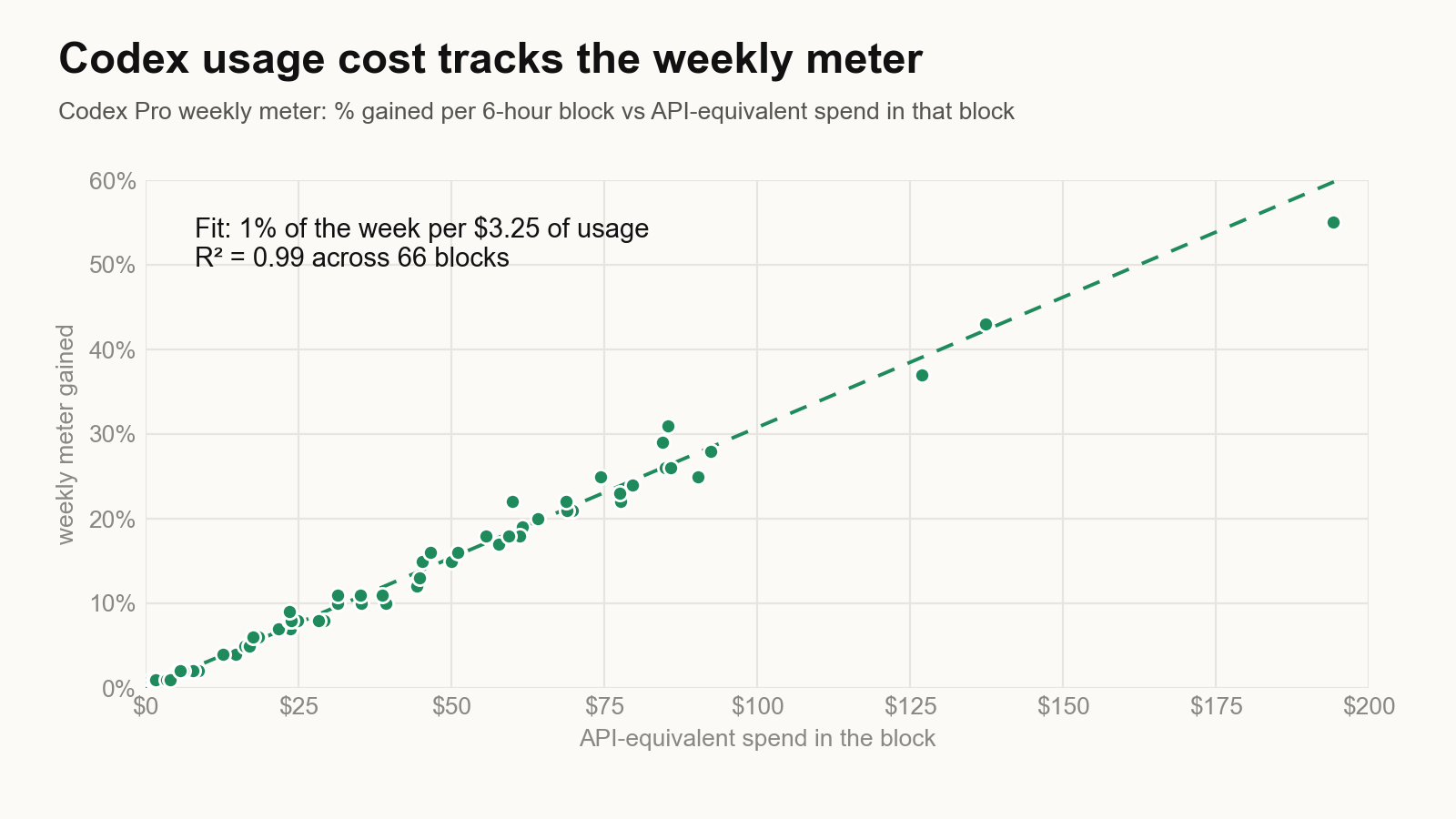
Limits of this measurement:
- One account per vendor, one person’s coding work, measured over a few weeks.
- Different models on each side, and different weeks of work. We compare usage, not quality.
- The Claude Max 5x sample is short (six days).
- Dollar values depend on each vendor’s list prices. Token counts depend on each vendor’s tokenizer.
- The meters show whole percentages.
FAQ
Which gives more usage, Claude Max 5x or Codex Pro 5x?
In our measurement, Claude Max 5x: about $1,248 of API-equivalent usage per week against $325, and about 2.8x the output tokens. Part of the dollar gap comes from OpenAI’s higher list prices, but in daily use Claude also got far more work done.
Are Codex’s frequent resets worth a lot?
Less than they seem. Each reset also moves the weekly reset date to seven days later, so you only gain the days you would have waited. Many arrive on their own, some with almost the whole week still unused.
Does Codex Pro have a 5-hour limit?
Not in September and October 2026: Codex Pro 5x had only a weekly limit, and OpenAI’s pricing page says Pro plans currently have no five-hour limit. Codex Plus and Claude Max have both a 5-hour and a weekly limit.
Is Codex Pro 5x five times Codex Plus?
We measured between 3.7x and 5.1x, depending on how you correct for the models used. OpenAI described the $100 tier as 5x Plus.
Do all Codex models use the limit at the same rate?
No. Per dollar of API list price, GPT-6.1 Sol used about 1.5x as much of the weekly limit as GPT-6 Astra, and Luna much less.