What is an AI agent? What they do and what they can't do
What is an AI agent? Software that owns a process end to end. What they actually do, their real limitations, and how they compare to chatbots and automations.


What is an AI agent? An AI agent is software that owns a task end to end. You give it a goal, it figures out the steps, uses tools to run them, and reports back with results. No prompting required between steps. No human clicking buttons to move it along.
That’s the short answer. But what can AI agents actually do, and where do they fall short? Most content you’ll find comes from vendors selling platforms. We deploy autonomous AI agents as AI teammates inside real businesses, so what follows is drawn from daily experience, not a product roadmap.
What can AI agents do?
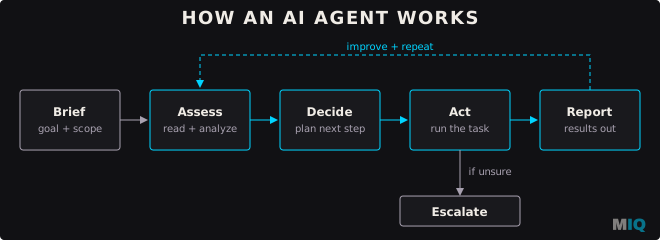
AI agents assess their environment, take action, learn from feedback, and escalate when they hit their limits. Here are the core AI agent capabilities in practice:
- Assess the situation by reading emails, messages, documents, and database entries, then deciding what matters
- Take action based on rules and judgment: respond, update a system, flag something, create a report
- Improve with feedback. Store what worked, get corrected on what didn’t, handle more edge cases over time
- Escalate when it hits something outside its scope
What this looks like in production
We run three AI teammates in production. Not demos. Not pilots. Real work, every day.



We brief each agent like a new hire: here’s your role, here’s what you own, this is your toolset, here’s how you report back. After that, they run.
AI agent limitations: what they can’t do
Even a well-deployed AI teammate has hard limits. Agents can’t exercise judgment that requires deep context, can’t set creative strategy, are digital-only, and struggle with long-term memory. Here’s each one in detail:
Judgment that requires deep context
An agent can follow rules. It can’t read the room. Decisions that require years of relationship history, cultural nuance, or institutional knowledge are beyond what any agent handles today. A human who’s worked with a client for three years knows when to push and when to back off. An agent doesn’t have that context and can’t build it from a document.
Creative strategy and original thinking
Agents are good at generating volume: variations, drafts, brainstorms. They’re bad at setting direction. A 2026 Université de Montréal study found the most creative humans still outperform every AI system tested. Use agents to explore options. Keep strategy with the people who understand where the business is going.
They live in the digital world
Agents operate on screens. They read documents, send messages, update systems. They can’t walk a factory floor, shake a hand, or notice that a team member is burned out. Physical presence and human observation are still outside their reach. Robotics is closing this gap, but in 2026, agents are digital teammates only.
Long-term memory is still unsolved
An agent running 24/7 produces a lot of data. Logs, chat histories, session records, context databases. The more data accumulates, the harder it is for the agent to find what’s relevant. Performance degrades. What to remember and what to forget is harder than it sounds.
We’re still figuring this out. So is everyone else. Today, an agent’s ability to retain and use knowledge over months is a real constraint.
Beyond these structural limits, there are practical challenges to get right when deploying agents:
They need guardrails or they’re a liability
An agent without boundaries is an attack surface. Prompt injection, key leakage, private data exposure. These aren’t theoretical risks. NIST launched an entire AI Agent Standards Initiative in 2026 to address agent security, interoperability, and trust. They’re what happens when you give an agent broad access and hope for the best.
Every agent we deploy runs with an explicit permission set. It can only access tools and data the client has approved. External communications require a human checkpoint. No exceptions.
The briefing makes or breaks it
An agent with a vague goal (“help with operations”) will produce vague results. An agent with a specific, measurable goal (“process every incoming invoice and flag discrepancies within 2 hours”) will outperform the vague one every time. Give an agent one task with a clear outcome. Five tasks with loose definitions won’t work.
The same goes for knowledge. The biggest deployment mistake we see: teams hand an agent a two-sentence prompt and expect it to match a decade of experience. An agent that does the job “wrong” usually wasn’t given the right materials. No documentation, no examples of previous work, no reference for what good looks like. Give it access to your existing documents, past examples, and clear standards, and the output changes completely.
They make mistakes and need supervision
Agents hallucinate, misinterpret edge cases, and occasionally get things flat wrong. But they leave a complete trail. Every action is logged. When something goes wrong, you trace it back to the exact decision point and fix it. What matters: the agent learns from the correction.
Treat it like onboarding. You wouldn’t let a junior employee send client emails unsupervised on day one. Start with a human reviewing every external-facing output. When the agent proves reliable, loosen the supervision gradually. Our agents have human checkpoints on all external communications. That’s by design, not by limitation.
AI agent vs chatbot vs automation
The AI agent vs chatbot question comes up a lot. A chatbot waits for you to ask it something. An agent is already working. That’s the core difference.
A chatbot is reactive. You prompt, it responds. Close the window and it stops. Microsoft’s own comparison draws the same line: chatbots respond to prompts, agents act on their own.
An automation (Zapier, Make) runs a fixed sequence. If X happens, do Y. It’s reliable but rigid. It can’t adapt when the process changes or handle cases it wasn’t programmed for.
An AI agent owns a process. It decides what steps to take, runs them, adapts when things change, and runs without being prompted. The bar we use: if you’d describe what it does as “a job” rather than “a feature”, that’s an agent.
| Chatbot | Automation | AI Agent | |
|---|---|---|---|
| Starts working | When you prompt it | When triggered | On its own, 24/7 |
| Handles change | No | No | Yes, adapts |
| Owns the outcome | No | No | Yes |
| Improves over time | No | No | Yes, with feedback |
An automation is a recipe. An agent is a teammate.
Who should use AI agents (and who shouldn’t)?
An AI agent for small business works best in teams of 10 to 50 people with repeatable processes eating their time. Companies where the founder, COO, or ops lead feels the pain of manual work daily, but doesn’t have the budget or timeline to hire another person. An AI agent for business fills that gap: enough capacity to make a difference, at a fraction of a full-time salary.
The sweet spot: your team already has an internal messaging channel (Slack, Teams), cloud storage (Google Drive, SharePoint), and a task board (Jira, Linear, Notion). You have processes that could be described to a new hire. You’re willing to trust an agent with a defined scope and let it run.
Agents aren’t for everyone. If your business needs a human approving every single action, you’re not ready for an autonomous agent. That’s not a criticism. It’s a timing question. The right time is when you can define clear boundaries and trust the agent to operate within them.
They also aren’t a shortcut for companies that haven’t defined their processes yet. An agent can’t automate chaos. If a human can’t describe the process step by step, an agent can’t run it.
The more organized your company is, the better agents will perform. Teams that already document their processes, use task boards, and have clear handoffs between people are set up for agents to slot right in. The structure you’ve already built is exactly what an agent needs to operate.
The honest state of AI agents in 2026
The technology is real. The hype outpaces the reality.
McKinsey reports 88% of organizations use AI in at least one function. Most haven’t moved past pilot stage with agents.
Gartner predicts 40% of enterprise apps will feature AI agents by end of 2026. At the same time, over 40% of agentic AI projects will be canceled by 2027 due to unclear value or inadequate controls.
The ones that succeed share a pattern: narrow scope, explicit permissions, daily reporting, and human oversight where it counts.
The agents that work at MulletIQ work because the deployment is disciplined, not because the technology is perfect. Focused goals, clear guardrails, and a willingness to treat the agent like a new hire instead of a magic fix. That’s what makes the difference between an AI teammate that delivers and a pilot that gets abandoned.
Ready to see if an AI teammate fits?
If your business is losing hours to processes that should run themselves, an AI teammate could be the next hire you make. Not a chatbot. Not another SaaS subscription. A teammate that owns the process end to end.
One conversation. We’ll tell you exactly what an agent can and can’t do for your team.
Get in touch. Founding client rate: €2,500/mo €1,000/mo.