AI agent vs new hire: the true cost in the UK
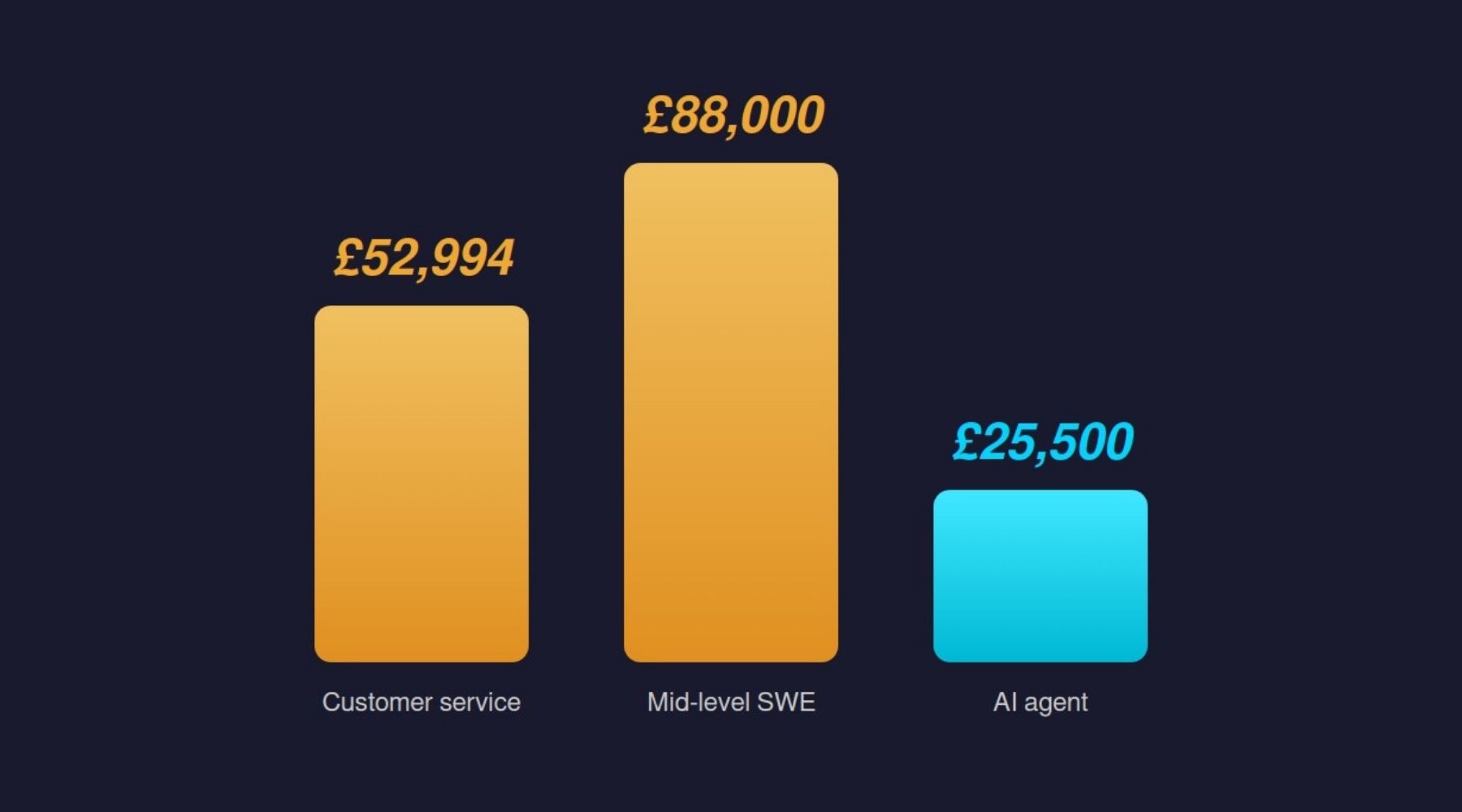
What does hiring really cost a UK employer? A £25,000 hire costs £53,000 in year one, a £50,000 developer £88,000. An AI agent costs £25,500/year.


I once hired a senior software engineer through a headhunter. Salary: £7,000 a month. The headhunter took 25% of the annual salary. That’s £21,000.
Seven months later, the developer left.
That experience made me look harder at what hiring actually costs. The real number. The one nobody puts in the job posting.
So I ran the numbers. All of them. What hiring actually costs, what an AI agent costs, and where the two cross.
What hiring actually costs a small business
Take a customer service rep in the UK. The job ad says £25,000. Here’s what you actually pay in year one:
| Year 1 | Ongoing | |
|---|---|---|
| Base salary | £25,000 | £25,000 |
| Employer NI (15% above £5K) | £3,000 | £3,000 |
| Pension (3%) | £564 | £564 |
| Recruitment fees (20%) | £5,000 | — |
| Onboarding ( | £4,530 | £1,530 |
| Equipment | £1,500 | £500 |
| Workspace | £5,400 | £5,400 |
| Management overhead | £5,000 | £5,000 |
| HR and admin | £3,000 | £3,000 |
| Total | £52,994 | £43,994 |
A 2.12x multiplier. A £25,000 hire costs nearly £53,000 in year one. Even after you’ve absorbed the one-time costs, the ongoing run rate is £44,000, or 1.76x the number on the offer letter.
The same calculation for a mid-level software engineer at £50,000 lands at roughly £88,000 in year one. Higher NI contributions (15% above £5K on a larger base), £10,000 in recruitment fees, and more expensive onboarding. A 1.77x multiplier on the salary.
UK employer National Insurance jumped to 15% in April 2025, up from 13.8%, with the threshold dropping from £9,100 to £5,000. Small businesses absorbed the biggest hit. PayFit calculated that a £27,600 salary costs £62,890 in year one, a 2.28x multiplier. Their breakdown matches ours.
The time tax
Money is the obvious cost. Time is the one that actually hurts.
The average UK vacancy takes 48 days to fill. In the US, the latest numbers show 63 to 68 days. Tech roles push past 70.
During that time, 45% of business leaders spend more than half their working hours on hiring. For a founder at a 20-person company, that’s not a task. It’s your primary occupation for two months.
Then the person starts. Oxford Economics found it takes 28 weeks on average to reach full productivity, with £25,181 in lost output during the ramp-up. Sales roles take about 6 months. Software developers: 6 to 12. New hires operate at 25% productivity in their first month.
Stack that timeline: 2 months to hire, 7 months to full speed, 25% output in month one.
Now the kicker. Annual turnover at small firms runs at 18.2%, compared to 13.6% at companies with 1,000+ employees. Across your whole team, nearly one in five roles turns over every year. Each one restarts the cycle: recruit, onboard, wait, hope they stay.
The cost nobody puts in a spreadsheet
42% of SME owners say staff management is their single biggest source of stress. Not cash flow. Not sales. Managing people.
That tracks. When you hire someone at a 15-person company, you’re not just adding capacity. You’re adding 1:1 meetings, performance conversations, mediation when things get tense, and the constant background hum of being responsible for someone’s income.
76% of business owners report medium or high stress levels. 42% have experienced burnout in the past month. The stat that should worry you: owners with positive mental wellness are nearly twice as likely to be running a growing business. 73% versus 38%.
Stress isn’t just uncomfortable. It’s bad for the company.
Every hire adds to that load. Not because people are a problem, but because management is a skill that takes time, energy, and attention away from the work only the founder can do.
The cost of a bad hire
74% of employers admit to having hired the wrong person. 95% of organizations admit to making at least one bad hire per year.
The average cost to replace someone earning £25,000 or more: £30,614 according to Oxford Economics. That’s £25,181 in lost output during the replacement’s ramp-up, plus £5,433 in direct costs.
For a 15-person company, one bad hire doesn’t just cost money. It costs a quarter. Projects stall, team morale dips, the founder spends weeks managing the fallout instead of building the business.
The worst part: when a hire doesn’t work out, the sunk cost is permanent. The recruiter fee is spent. The onboarding time is gone. You can’t undo months of underperformance.
AI agent pricing vs employee cost
An AI agent, what we call an AI teammate, costs €2,500 (~£2,125) per month.
No headhunter fees, no job board listings, no 48 days of interviews. The agent is productive in under two weeks, not months. No NI, no pension, no holiday allowance, no desk, no laptop, no office lease, no 1:1s, no performance reviews, no HR admin.
An agent works 168 hours a week. A full-time employee works 40. 4.2x the availability, including weekends and holidays.
Here’s the full AI agent cost vs employee cost, side by side:
| Customer service (year 1) | Mid-level SWE (year 1) | AI agent (annual) | |
|---|---|---|---|
| Total cost | £52,994 | ~£88,000 | £25,500 |
| Time to productive | 7+ months | 6-12 months | Under 2 weeks |
| Weekly availability | 40 hours | 40 hours | 168 hours |
| Turnover risk | 18.2% annual (small firms) | 18.2% annual (small firms) | Zero |
| Recruitment cost | £5,000+ | £10,000+ | Zero |
| Need more capacity? | Hire again | Hire again | Add scope |
For a customer service role: less than half the cost. For a mid-level developer: less than a third. Productive 28 weeks sooner, zero turnover risk.
€2,500 (~£2,125) a month. That’s the AI agent monthly cost, for operational roles and technical functions alike: customer service, data entry, reporting, lead qualification, document review, scheduling, but also software development, code reviews, and technical operations.
Proof: we run on this
I spent a decade writing code and managing engineering teams. Now I run a software company where I’m the only human. My agents write every line of code, review every pull request, run outreach, and manage operations. I set direction. They build.
Jett, our developer agent deployed at Seef AI, ships 50+ production commits per day. Reviews every pull request before merge. Maintains the entire codebase. Seef AI is a shipped, paying product built largely by this agent.
Kai, our chief of staff agent, saves roughly 6 hours per week on admin. What I didn’t expect: Kai surfaced 23 missed opportunities I’d overlooked and drafted strategies, action plans, and ready-to-send emails for each one. I barely had to think. The agent has access to all of the company’s knowledge at once, so it spots patterns faster than any person still building context.
Bex, our sales agent, runs 500+ personalized outreach sequences per month. Not templates. Messages tailored to each prospect based on actual research.
All operating results. No projections.
When an agent isn’t the answer
An agent can’t do everything a person can. If I pretended otherwise, nothing else in this article would be worth trusting.
Agents can’t set product vision. They can’t navigate ambiguous strategy or read a room. High-level design decisions are still entirely on me. I function as the product lead: defining what needs to happen, breaking it into clear tasks, making judgment calls. That’s the human layer.
Relationship-heavy work stays human too. Complex negotiations, sensitive client conversations, leadership that requires empathy and presence. No agent handles that today.
Klarna bet big on replacing human support with AI. Within a year, they were rehiring. The lesson isn’t that AI doesn’t work. It’s that replacing entire departments at once doesn’t work. Most companies that cut headcount for AI did it based on speculation, not results. Only 2% based those decisions on actual AI performance data.
The right approach is targeted deployment. One agent, one well-defined process, clear permissions. Not “replace the team”. Replace the hire you were about to make for a repeatable, operational function.
Hire an AI agent or hire a person?
AI agents are already changing how companies hire. Solo-founded startups surged from 23.7% to 36.3% between 2019 and mid-2025. The fastest-growing companies are running leaner by design.
But the question for you is specific. For this role you’re about to fill, one that involves repeatable work, defined processes, and predictable patterns: would an agent do it better, faster, and at a fraction of the cost?
For a growing company with 10 to 50 people, the math is hard to argue with. An AI teammate costs €2,500 (~£2,125) a month, delivers in under two weeks, and works 168 hours a week. A customer service hire costs 2x the salary on the offer letter. A mid-level developer costs more than 3x the agent’s annual cost. Both take months to reach full speed, with 18% annual turnover risk.
MulletIQ deploys agents the same way you’d onboard a careful new hire. Start small. Give it a defined scope. Audit everything. Expand only when it earns your trust. Never too far, never too fast.
Curious what an AI teammate could do for your team? Book a free exploratory call. 30 minutes, zero obligation.